Put simply, Incoterms are the selling terms that the buyer and seller of goods both agrees to. The Incoterm clearly states which tasks,
costs and risks are associated with the buyer and the seller.
The Incoterm is agreed between the buyer and seller and states when the seller’s costs and risks are then transferred onto the buyer.
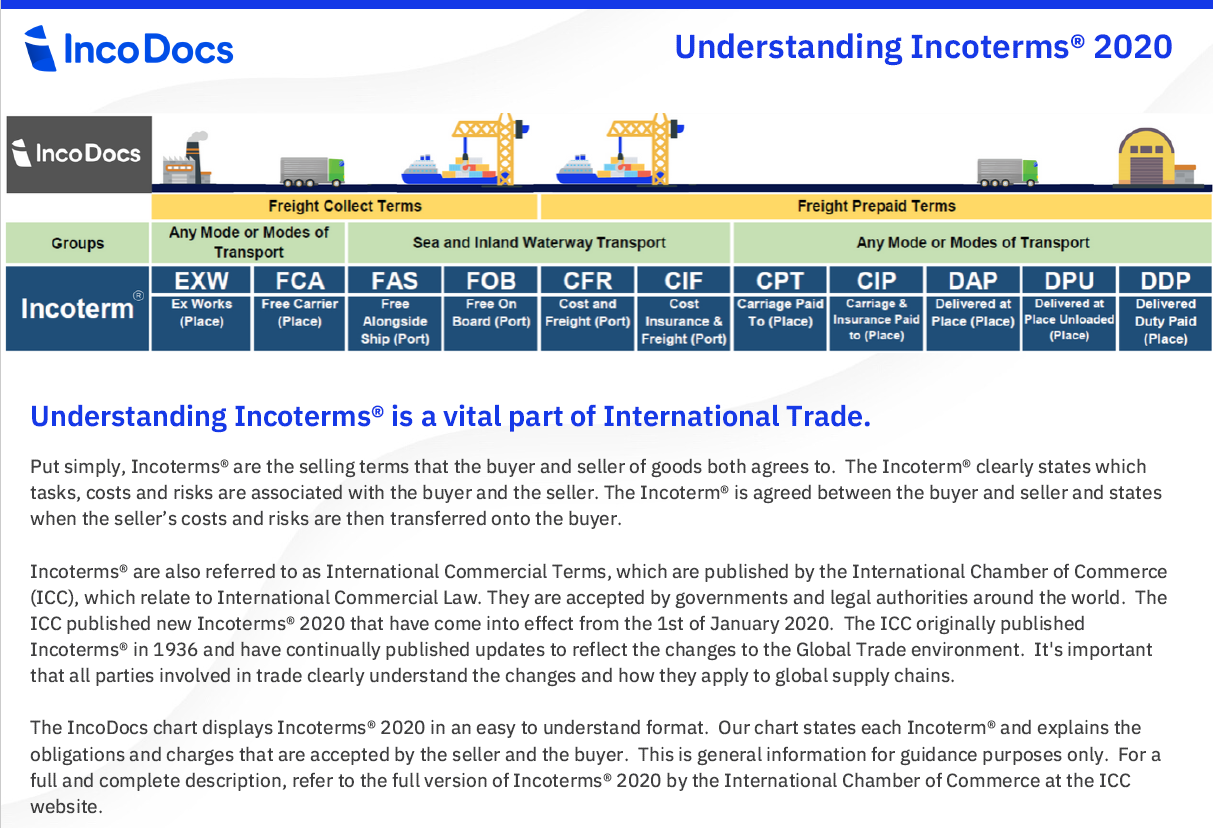
Incoterms are also referred to as International Commercial Terms, which are published by the International Chamber of Commerce (ICC),
which relate to International Commercial Law.
They are accepted by governments and legal authorities around the world. The ICC published new Incoterms 2020 that have come into effect
from the 1st of January 2020.
The ICC originally published Incoterms in 1936 and have continually published updates to reflect the changes to the Global Trade
environment. It's important that all parties involved in trade clearly understand the changes and how they apply to global supply chains.
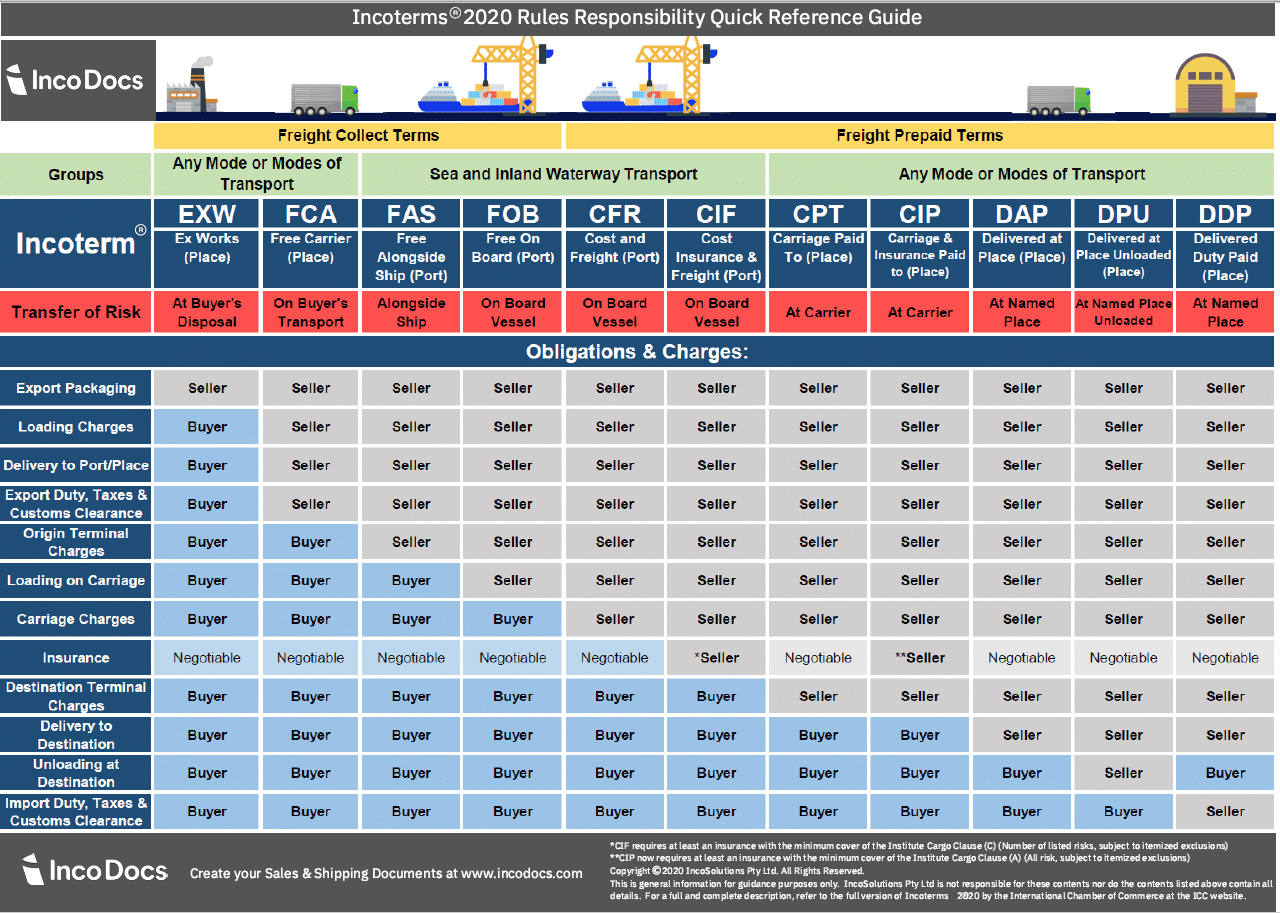
The below chart displays Incoterms 2020 in an easy to understand format. Our chart states each Incoterm and explains the obligations and charges that are accepted by the seller and the buyer.
This is general information for guidance purposes only.
Rules for any mode or modes of transport:
EXW - Ex-Works or Ex-Warehouse:
“Ex Works” means that the seller delivers when it places the goods at the disposal of the buyer at the seller’s
premises or at another named place (i.e.,works, factory, warehouse, etc.). The seller does not need to load the
goods on any collecting vehicle, nor does it need to clear the goods for export, where such clearance is
applicable.
FCA - Free Carrier:
“Free Carrier” means that the seller delivers the goods to the carrier or another person nominated by the buyer
at the seller’s premises or another named place. The parties are well advised to specify as clearly as possible
the point within the named place of delivery, as the risk passes to the buyer at that point.
CPT - Carriage Paid To:
“Carriage Paid To” means that the seller delivers the goods to the carrier or another person nominated by the
seller at an agreed place (if any such place is agreed between parties) and that the seller must contract for and
pay the costs of carriage necessary to bring the goods to the named place of destination.
CIP - Carriage And Insurance Paid To:
“Carriage and Insurance Paid to” means that the seller delivers the goods to the carrier or another person
nominated by the seller at an agreed place (if any such place is agreed between parties) and that the seller
must contract for and pay the costs of carriage necessary to bring the goods to the named place of destination.
‘The seller also contracts for insurance cover against the buyer’s risk of loss of or damage to the goods during
the carriage. The buyer should note that under CIP the seller is required to obtain insurance only on minimum
cover. Should the buyer wish to have more insurance protection, it will need either to agree as much expressly
with the seller or to make its own extra insurance arrangements.”
DAP - Delivered At Place:
“Delivered at Place” means that the seller delivers when the goods are placed at the disposal of the buyer on
the arriving means of transport ready for unloading at the named place of destination. The seller bears all risks
involved in bringing the goods to the named place.
DPU - Delivered At Place Unloaded:
“Delivered At Place Unloaded” means that the seller delivers when the goods, once unloaded, are placed at the
disposal of the buyer at a named place of destination. The seller bears all risks involved in bringing the goods
to, and unloading them at the named place of destination.
DDP - Delivered Duty Paid:
“Delivered Duty Paid” means that the seller delivers the goods when the goods are placed at the disposal of
the buyer, cleared for import on the arriving means of transport ready for unloading at the named place of
destination. The seller bears all the costs and risks involved in bringing the goods to the place of destination
and has an obligation to clear the goods not only for export but also for import, to pay any duty for both export
and import and to carry out all customs formalities.
Rules for sea and inland waterway transport:
FAS - Free Alongside Ship:
“Free Alongside Ship” means that the seller delivers when the goods are placed alongside the vessel (e.g., on a quay or
a barge) nominated by the buyer at the named port of shipment. The risk of loss of or damage to the goods passes when
the goods are alongside the ship, and the buyer bears all costs from that moment onwards.
FOB - Free On Board:
“Free On Board” means that the seller delivers the goods on board the vessel nominated by the buyer at the named
port of shipment or procures the goods already so delivered. The risk of loss of or damage to the goods passes when the
goods are on board the vessel, and the buyer bears all costs from that moment onwards.
CFR - Cost and Freight:
“Cost and Freight” means that the seller delivers the goods on board the vessel or procures the goods already so
delivered. The risk of loss of or damage to the goods passes when the goods are on board the vessel. the seller must
contract for and pay the costs and freight necessary to bring the goods to the named port of destination.
CIF - Cost, Insurance and Freight:
“Cost, Insurance and Freight” means that the seller delivers the goods on board the vessel or procures the goods
already so delivered. The risk of loss of or damage to the goods passes when the goods are on board the vessel. The
seller must contract for and pay the costs and freight necessary to bring the goods to the named port of destination.
‘The seller also contracts for insurance cover against the buyer’s risk of loss of or damage to the goods during the
carriage. The buyer should note that under CIF the seller is required to obtain insurance only on minimum cover. Should
the buyer wish to have more insurance protection, it will need either to agree as much expressly with the seller or to
make its own extra insurance arrangements.”
What does ‘Freight Collect’ and ‘Freight Prepaid’ mean? :
Freight Collect and Freight Prepaid are common terms used in International Freight. It is very important to understand
the difference, it is basically a statement of who will be paying for all the International freight charges. If you export your
goods on ‘Freight Collect’ terms (EXW, FCA, FAS and FOB are all Freight Collect terms) that means that the importer (your
buyer) will ‘collect’ and pay all of the freight charges on their side, you will not have to pay any freight at all.
If you are the exporter and sell the goods on CFR, CIF, CPT, CIP, DAP, DPU or DDP terms, this means that you will pay for
the freight charges (‘Freight Prepaid’ – you will pre-pay the freight charges). These are linked to the selling terms of your
invoice, if you are selling your goods on ‘FOB’ terms (Free on Board) then you are only covering the costs to get the goods
loaded on board the vessel. All charges thereafter will be charged to the receiver of the goods (consignee) – so it will be
Freight Collect. These freight terms are stated on the Bill of Lading, the document issued by the shipping line or freight
forwarder.
Resources:
International Chamber of Commerce (ICC) IncotermsR 2020